Beyond Translation: How Equipo Renacer Is Closing the Care Gap
Last month, Eliot was honored to share the stage at NatCon 2026 — the nation’s leading mental and behavioral health conference — for the first time. Alongside fellow researchers, practitioners and systems leaders from across the country, two of our teams presented original clinical work. As we mark Mental Health Awareness Month, we’re sharing what they brought to that stage: a culturally grounded model of care, and a vision for the field to rethink how evidence-based treatment actually gets delivered.
In Lynn, Massachusetts, more than 44% of residents identify as Hispanic or Latino. For years, that community and the behavioral health system meant to serve it were speaking different languages — not just linguistically, but culturally.
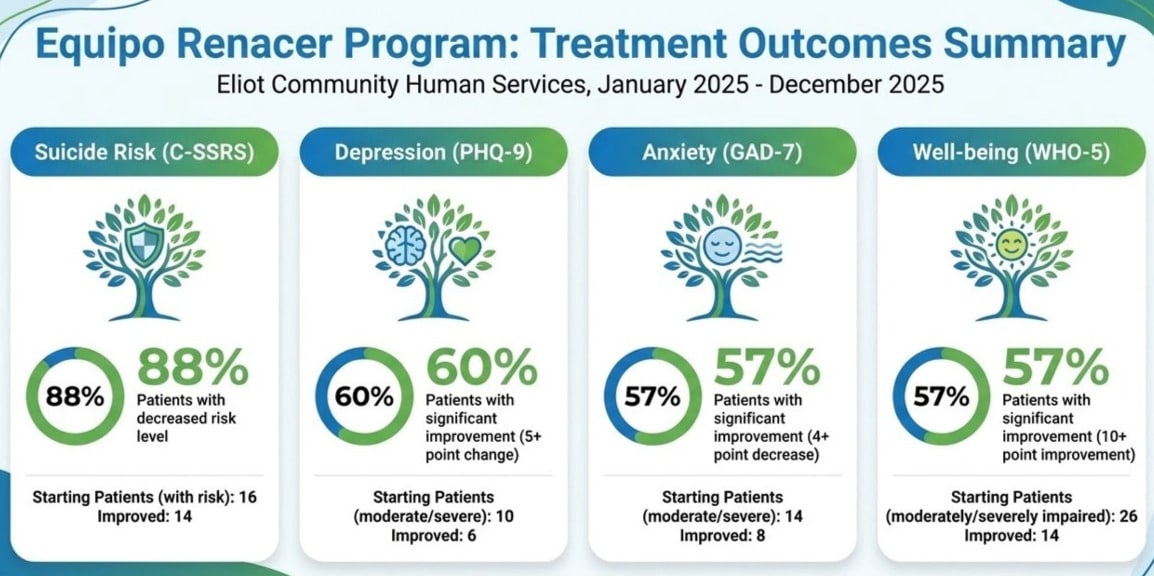
Eliot’s Equipo Renacer team set out to close that gap. Not with a translation service. With a fully Spanish-speaking, multidisciplinary care team built from the ground up around the concept of familismo — the deeply held cultural value of loyalty, collective identity, and mutual care.
This May, as the field marks Mental Health Awareness Month, it’s worth sitting with what that actually means in practice.
The problem isn’t just language. It’s safety.
When a person can’t express their inner world in their native tongue, the stakes aren’t just clinical inconvenience — they’re diagnostic accuracy and safety. Misdiagnosis rates rise. Trust erodes. People stop showing up. Equipo Renacer was built on the recognition that shared emotional language is a precondition for real care, not a nice-to-have.
Culture as a clinical tool.
The team — a therapist, prescriber, recovery coach, and case manager working in daily coordination — doesn’t just deliver evidence-based care in Spanish. They’ve woven cultural values into their clinical approach. Personalismo shapes how trust is built. Familismo moves the unit of treatment from the individual to the family system. Somatic expressions of distress, which can often be misread by Western-trained clinicians, are understood for what they are.
“Our culture is our most effective clinical tool,” the team shared.
Consider the case of José — a 49-year-old man navigating early recovery, housing instability, drug court requirements, and separation from his children, all while new to Lynn with no Spanish-speaking network to lean on. The Equipo Renacer team walked alongside him for ten months: connecting him to peer support, addressing instability, helping him see his strengths as clearly as his struggles. He completed the program and transitioned to outpatient care. His goals: employment, housing, reconnecting with his kids.
That’s what culturally specific care looks like when it’s fully resourced and fully committed.
A model worth replicating.
Equipo Renacer isn’t just serving a community — it’s demonstrating what’s possible when a team reflects the community it serves. The lessons are practical and transferable: build multidisciplinary pods, hold daily huddles in the language of the people you serve, treat systemic advocacy as a clinical intervention, and train the broader system on the realities of the communities it’s supposed to reach.
Mental Health Awareness Month is a moment to celebrate progress. It’s also a moment to reflect that closing gaps is possible.
Construyendo el Puente Juntos. Building the Bridge Together.