Rethinking the Playbook: How Eliot Is Making Evidence-Based Care Work for Everyone
Last month, Eliot was honored to share the stage at NatCon 2026 — the nation’s leading mental and behavioral health conference — for the first time. Alongside fellow researchers, practitioners and systems leaders from across the country, two of our teams presented original clinical work. As we mark Mental Health Awareness Month, we’re sharing what they brought to that stage: a culturally grounded model of care, and a vision for the field to rethink how evidence-based treatment actually gets delivered.
There’s a problem hiding in plain sight in behavioral health: the very system designed to get people the best possible care has, in many ways, made that care harder to access.
At NatCon 2026, Eliot’s clinical leadership named it directly — calling it the “EBP Industrial Complex.” It’s a pointed phrase, but the argument behind it is grounded in data and years of on-the-ground experience.
How a good idea became a bottleneck.
Evidence-based practices are genuinely valuable. The problem is the infrastructure that’s grown up around them. Researchers are rewarded for developing new protocols, not integrating existing ones. Training is expensive, time-consuming, and siloed by diagnosis. A clinician certified in one approach may be poorly equipped to treat the full complexity of the person sitting across from them. The result: treatment can sometimes be shaped by what a clinician was trained in, not by what a client actually needs.
For community mental health providers — who serve high-acuity populations with limited resources — that bottleneck has real consequences. Workforce capacity shrinks. Access suffers. Supportive therapy becomes the default not because it’s the best fit, but because it’s what’s available.
Eliot’s answer: a framework built for the real world.
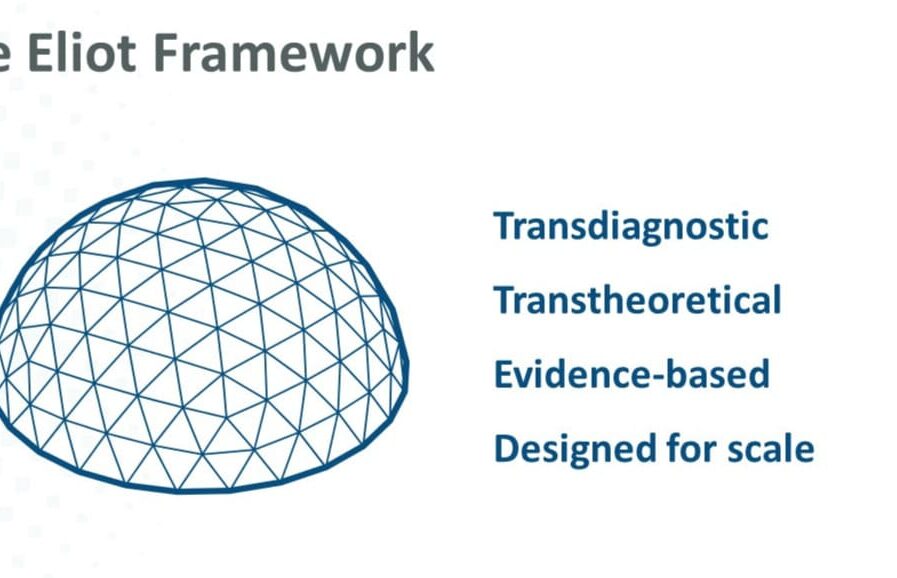
Rather than bolt on another protocol, Eliot’s clinical team spent years developing something different — a transdiagnostic, transtheoretical framework designed to work at scale in community mental health. The idea is straightforward: instead of asking “what diagnosis does this person have and what protocol does that diagnosis call for?” ask “what patterns are maintaining this person’s suffering, and what interventions target those patterns most effectively?”
That shift — from diagnosis to pattern, from protocol to competence — changes everything about how clinicians are trained and how care is delivered. It also centers the individual and works toward their own empowerment.
The outcomes back it up.
At Eliot’s Community Behavioral Health Centers, this approach produced results the team shared openly and proudly at NatCon: 92% of patients with moderate to high suicide risk demonstrated a decrease in risk level. 62% of patients with moderate to severe depression showed meaningful symptom improvement. Anxiety and wellbeing scores followed similar trajectories — and for Spanish-speaking patients served by Equipo Renacer, outcomes matched or exceeded the overall CBHC results.
These aren’t outcomes from a controlled research trial with carefully selected participants. They’re from a community-based behavioral health and human services nonprofit working with people navigating housing instability, trauma, substance use, justice system involvement, and chronic stress — in many cases simultaneously.
What Mental Health Awareness Month asks of us.
Awareness is the right starting point. But the field has known for a long time that the gap between what evidence says works and what people actually receive is wide. Closing it requires more than additional training or protocols. It requires rethinking how care is organized, how clinicians are developed, and what we’re actually optimizing for.
Eliot doesn’t claim to have solved it. But the framework being built here — and the outcomes it’s producing — suggests a direction worth following.
The goal isn’t a better protocol. It’s a better system.