The Clubhouse Model and the Power of Community
Mental Health Awareness Month 2026 | Featuring Insights from John Kirton, Renaissance Club Director
Many mental health programs are built around symptoms. The Clubhouse model is built around people.
That distinction matters more than it might seem. At Eliot’s Renaissance Club — and at more than 300 Clubhouses operating in over 30 countries — members with a diagnosed mental illness don’t come to receive services. They come to work, to contribute, and to belong.
“I would describe the Clubhouse as a workplace,” says John Kirton, Director of the Renaissance Club. “Members voluntarily participate in all aspects of running the Clubhouse. It gives members ownership and builds a sense of community.”
That ownership is structural, not symbolic. Members and staff run the Clubhouse side by side as equals. Changes go before the full membership for a consensus vote. Members weigh-in on everything from hiring decisions to what’s on the lunch menu. The goal isn’t programming, it’s partnership.
A Standard Worth Earning
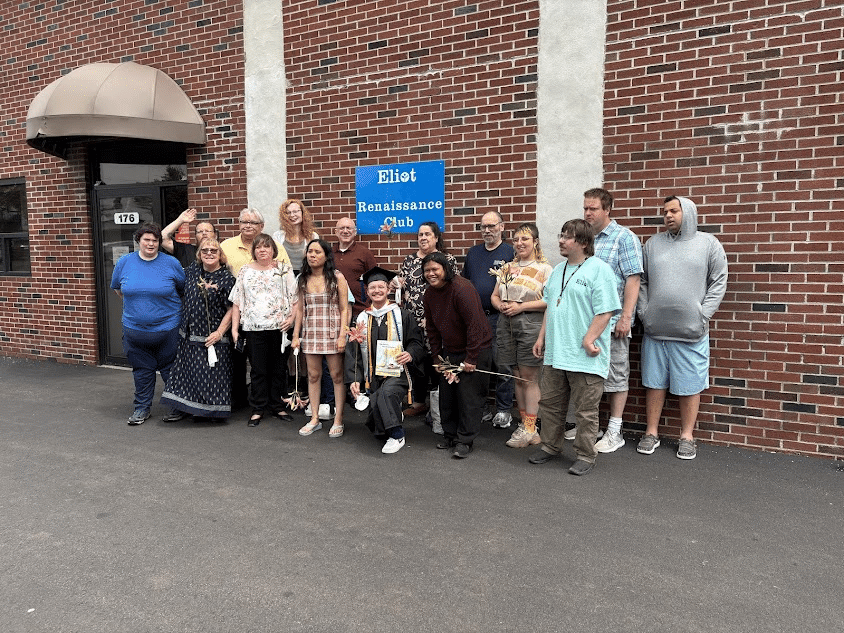
Eliot’s Renaissance Club recently completed the Clubhouse International accreditation process, one of the most rigorous quality reviews in the behavioral health space. An independent team — one staff member and one Clubhouse member, drawn from accredited programs around the world — spends three days embedded in the Clubhouse, evaluating its adherence to 37 global standards. They participate in daily operations, meet with leadership, and talk directly with members.
“They were very strength-based and down to earth,” John says of the accreditation team. “Just so focused on membership and building up the Clubhouse.”
The accreditation isn’t a compliance exercise. It’s a reckoning with a central question: Is this Clubhouse actually working the way it’s supposed to? Are members supported in their employment, educational, interpersonal, and wellness goals? Are staff and members genuinely working side by side?
Earning that accreditation reflects the whole community — the members who showed up, contributed, and helped shape what the Renaissance Club has become.
Paying It Forward
John recently completed Clubhouse International faculty training, joining roughly 120 evaluators conducting accreditations worldwide. The training is intensive: hours spent reviewing self-studies, stress-testing recommendations, grounding every observation in the standards and the rationale behind them.
Now he’s the one walking into other Clubhouses. His approach: ask a lot of questions, spend as much time with members as possible, and lead with what’s working.
“I want to tell them all the great things I see,” he says. “What feedback can I give that will help this Clubhouse be the best version of itself?”
That orientation — strength-based, member-centered, community-first — is exactly what the model asks of everyone inside it.
In Their Own Words
This month, the Renaissance Club released something that grew out of the membership itself: a book of personal essays, poetry, and artwork by members sharing their lived experiences with mental illness.
It started as a fundraising idea. It became something more.
“My hope is that people who read it see the person and not the symptoms,” John says. “That they look at a family member or a stranger with a diagnosis with a little more empathy and respect. And most importantly — if someone with a diagnosis reads this — you are not alone, and you are capable of doing great things.”
That’s the Clubhouse model in four sentences. During Mental Health Awareness Month, it’s worth saying plainly: community is treatment. Belonging is medicine. And when we build systems that see people instead of diagnoses, we get better outcomes — and a more human world.
The Renaissance Club is part of Eliot Community Human Services. Learn more.