table of contents
At Eliot, OT isn’t solely about exercises or equipment. It helps participants reclaim the everyday life that makes mental health recovery real — and sustainable.
Ask most people about occupational therapy, and it’s likely they’ll picture someone helping a stroke survivor regain hand strength, or guiding an athlete through complex injury rehabilitation. That assumption isn’t inaccurate — but for the individuals Eliot’s Adult Community Clinical Services (ACCS) program serves, it captures just one aspect of a richer story.
For adults living with serious mental illness — schizophrenia, bipolar disorder with psychosis, treatment-resistant depression — recovery is more than a clinical milestone or destination. It’s a daily practice, built from ordinary things that many of us may take for granted. A kept appointment. A home-cooked favorite meal, shared with loved ones. A hobby rediscovered after years away. A walk outside that happens because someone helped clear the path. These aren’t small wins. They are the substance of life.
Occupational therapy, practiced well, is the discipline that builds that path — one real, meaningful activity at a time.
“Sometimes the barriers to someone living the sort of life they want to live can actually be quite small. And it’s a very exciting thing to be able to help them remove one.” — Jack Norcross, Occupational Therapy Manager
What OT actually makes possible
In Eliot’s ACCS program, Jack Norcross leads a cohort of occupational therapists embedded within multidisciplinary care teams serving adults with complex mental and behavioral health needs, and in many cases physical comorbidities. The work begins with an occupational profile — not a list of symptoms, but a holistic picture of a person’s functioning, interests, goals, values, and environment. From there, the work is built around possibility and personal strengths.
For someone whose psychiatric diagnosis comes with cognitive challenges, an OT helps design practical systems — visual routines, medication management tools, streamlined household structures — that put control back in their hands. For someone managing complex medical conditions alongside mental illness, an OT can be the person who not only connects them to the right specialist, but sits alongside them in understanding recommendations and building a realistic plan to follow through. For someone who has been disconnected from the activities that once gave their life texture and joy, an OT works to rebuild that access by eliminating the financial, physical, and logistical barriers standing between a person and something that matters to them.
- Building daily capacity — Creating practical systems for finances, health, household, and appointments that put people in control of their own lives.
- Reclaiming meaning — Reconnecting people to hobbies, interests, and community: the activities that build resilience and a sense of self beyond diagnosis.
- Navigating medical care — Helping people access, understand, and act on complex care recommendations so good medical advice becomes real health outcomes.
- Expanding coping options — Finding personalized pathways to emotional regulation and stress tolerance that fit each person’s actual life, body, and history.
- Recovery on your own terms
What makes occupational therapy in behavioral health especially powerful is its commitment to self-determination. OTs don’t optimize for a clinical ideal. They work alongside the person to understand what a good life looks like to them and then find ways to get there. That partnership is not incidental. It is the whole model.
This is most visible when the complexity of a person’s situation is highest. As noted, people who have lived with serious mental illness for decades often carry medical comorbidities alongside it — arthritis, cardiac disease, diabetes, the physical effects of long-term treatment. As those realities accumulate, staying independent takes more creativity, more coordination, and more honest conversation. OT provides all three.
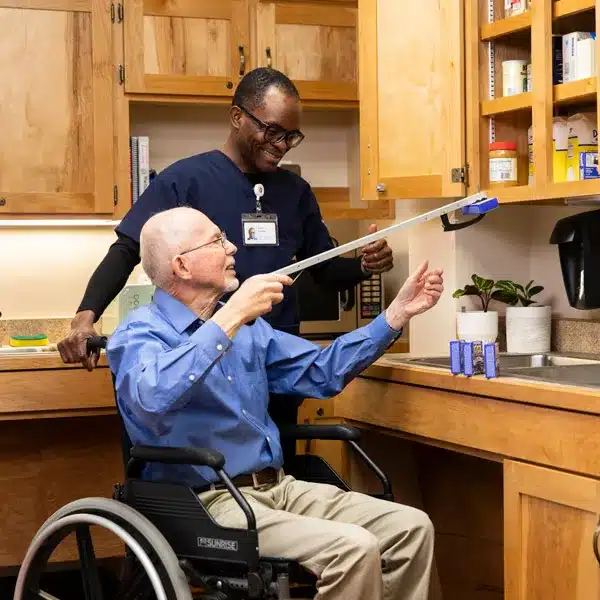
In practice: Jack recently worked with an elderly client — a long-term ACCS participant with serious mental illness, significant arthritis, and a history of falls — who has lived in their apartment for years and intends to stay. Her home is full of personal collections she has carefully arranged. It is theirs, and it reflects their identity and expresses their values.
The individual’s goal: stay in their home, on their terms, for as long as possible. Jack’s goal: support exactly that. The work became a genuine collaboration — identifying the modifications she was willing to make, honoring the ones they weren’t, and finding creative ways to reduce fall risk within a space that remained fully their own. As Jack describes it: “How can we meet both of these needs — a strong degree of autonomy and control of your life, while also remaining safe and being able to carry that independence forward.” That balance, reached together, is recovery and self-actualization in practice.
Stronger together through Care In Action
Eliot’s ACCS program is built on a fundamentally multidisciplinary, community-based model — clinicians, psychiatrists, case managers, peer specialists, recovery coaches, nurses, dietitians, housing specialists, and OTs, all contributing to a single coordinated care plan. What OT brings to that team is a particular supportive vision: one trained to see the whole person, to understand what meaningful daily life looks, feels and functions like for them, and to help them build toward it.
That vision matters most for people whose goals sometimes fall between the lines of traditional clinical categories — people who are stable but not yet fully back in their own lives. The person who has the diagnosis managed and is ready to take on more. The person who just needs the right tool, the right referral, or one good conversation to unlock something they’d started to believe was no longer possible.
That’s how occupational therapy at Eliot is a fundamental component of long-term mental wellbeing. Jack articulates it best:
“Recovery means more than staying housed and out of the hospital. It means living the fullness of life that everyone deserves — as a member of a community, with the same freedoms we all expect.”